

 Carbon accounting software
 MCP: Orki in your AI assistant
 LCA software
 ESG reporting software

For many companies, scope 3 is the hardest part of the inventory to measure, and it is where carbon accounting tools differ the most.
Carbon accounting software has become a crowded category. Some platforms are built for a first footprint in a small team, others for multinational disclosure programmes, others for manufacturers that also need product declarations. Comparing them on a single "best" ranking hides what actually matters: which deliverable you must produce, under which framework, with which internal resources.
This guide compares nine platforms by use case. Every vendor profile is based only on the vendor's own public pages, read on 25 November 2026, and states what each platform is best suited to.

In brief
- Nine platforms are compared: Greenly, Normative, Sami, Sweep, Plan A, Persefoni, Watershed, Seedling and Orki.
- Best by use case: Persefoni or Seedling to start for free; Seedling for UK SECR and PPN 006; Sweep or Watershed for multinational reporting; Persefoni, Sweep or Watershed for financed emissions; Sami for French methods with consultants able to work in the same platform; Orki for a corporate footprint plus product LCA and EPDs on one platform.
- Greenly and Normative announced in September 2026 that they are merging.
- Only three vendors in this panel publish a price or a free tier: Persefoni, Seedling and Orki.
- Editorial disclosure: this article is published by Orki, which is one of the platforms compared. Shortlist at least three vendors and request a demo from each.
What carbon accounting software does
Carbon accounting software measures an organisation's greenhouse gas emissions and turns them into reports. The reference framework is the GHG Protocol Corporate Standard, which splits emissions into three scopes:
- Scope 1: direct emissions from sources the company owns or controls, such as boilers and vehicles.
- Scope 2: indirect emissions from purchased electricity, heat and steam.
- Scope 3: all other indirect emissions in the value chain, from purchased goods and freight to the use and end of life of products sold.
A platform typically collects activity data such as invoices, ERP exports and travel bookings. It applies emission factors from databases such as ecoinvent, ADEME's Base Empreinte or national datasets, and calculates emissions in tonnes of CO2 equivalent. Most platforms then add a reduction plan and target setting aligned with the Science Based Targets initiative (SBTi). They also add reporting modules for frameworks such as the CSRD, CDP or national schemes.
How we compared the platforms
We used six criteria that change the outcome of a purchase, and checked each one on the vendor's own public pages on 25 November 2026.
We did not use review-site ratings: we could not read them reliably on the day of writing, and quoting one vendor's rating without the others would make the comparison unbalanced. When a point is not documented on a vendor's site, we say so rather than assume the vendor cannot do it.
The 9 platforms at a glance
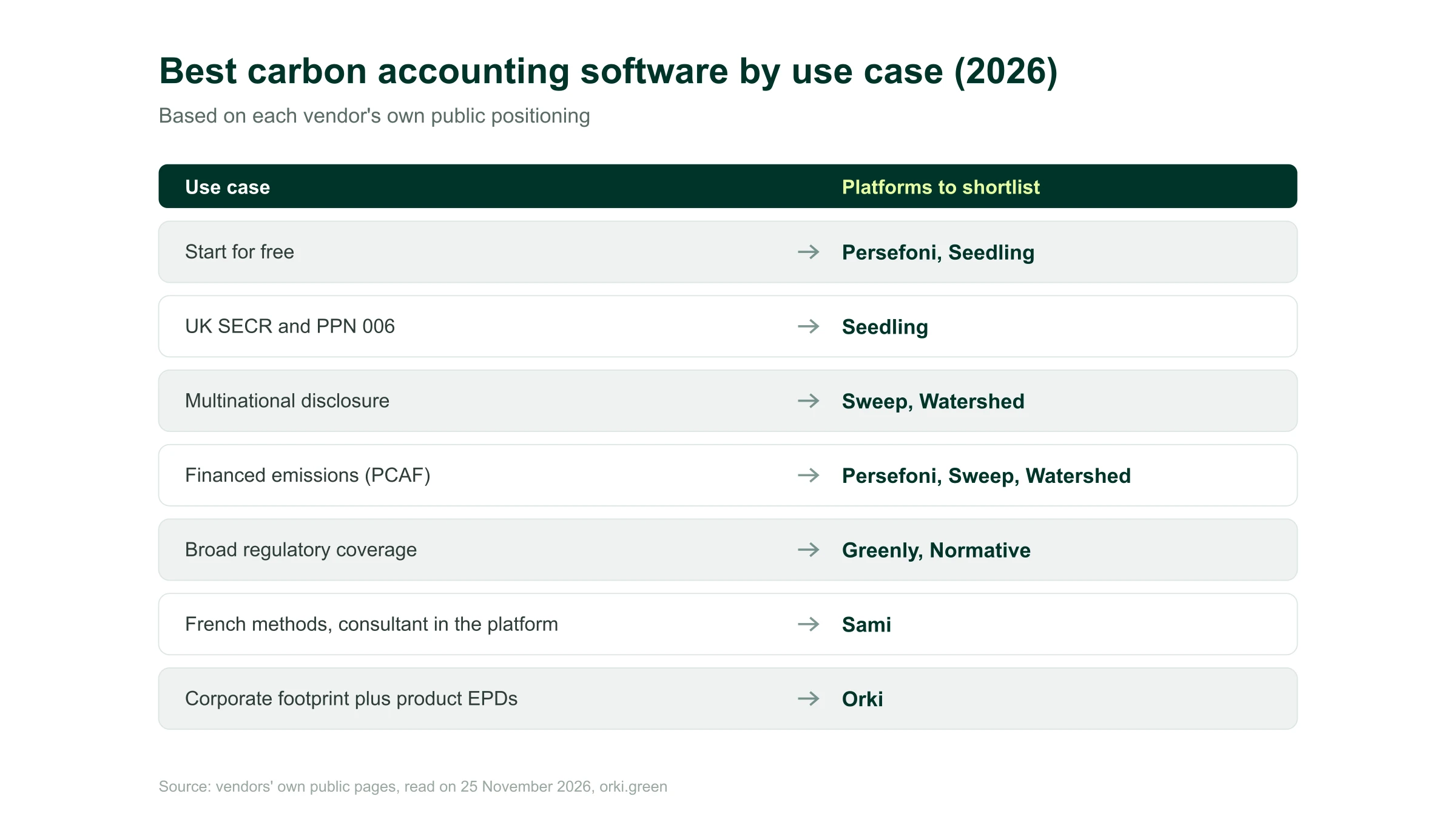 Which platform fits which use case, based on each vendor's own public positioning (25 November 2026).
Best carbon accounting software by use case
To start for free: Persefoni and Seedling
Persefoni Pro is free for a single user with no time limit. It covers scopes 1, 2 and all 15 scope 3 categories, a report builder and an AI assistant called Copilot. Seedling, based in Bath, offers a free Starter tier, with paid Core and Advanced tiers that add expert time. Free tiers suit a sustainability lead who needs a first inventory before asking for budget.
For UK reporting (SECR, PPN 006): Seedling
Seedling names SECR and PPN 006 on its homepage, together with ISO 14064, SBTi-aligned targets and CDP, and targets organisations of up to 2,000 employees. Persefoni also names UK SECR, and Normative lists SECR in its reporting suite. UK companies bidding for public contracts that require a carbon reduction plan should check the exact PPN 006 output in a demo.
For multinational disclosure programmes: Sweep and Watershed
Sweep, headquartered in Paris and London, names CSRD/ESRS, ISSB, CDP, California SB 253, UK SRS, GRI, PCAF, SFDR, SASB and the EU Taxonomy. It works with partners such as Capgemini, KPMG and ERM. Watershed was founded in 2019 in the United States and has offices in seven cities. It names Airbnb, Spotify and FedEx among its customers, supports CSRD and California SB 253 and SB 261, and submits to CDP via API. Both suit groups that report in several jurisdictions.
For financial institutions: Persefoni, Sweep and Watershed
Persefoni runs a dedicated product line for financial services and names PCAF, the standard for financed emissions. Sweep lists financial institutions as a segment and names PCAF and SFDR. Watershed offers a finance solution to measure and report financed emissions.
For broad regulatory coverage: Greenly and Normative
Greenly states 4,000 clients from SMBs to enterprises. It names GHG Protocol, SBTi, CSRD, CDP, CBAM, EUDR, ISO 14067, ISO 14040/44 and EPD, and its French site also has Bilan Carbone and VSME product pages. Normative, headquartered in Stockholm, has a calculation engine dating from 2014. TÜV SÜD evaluated it against ISO/IEC 25051 and the GHG Protocol, and every account includes a named GHG Protocol-certified advisor. In September 2026, the two companies announced that they are merging. Greenly states that no changes to existing contracts or pricing are planned as a direct result.
For decarbonisation planning in services and consumer sectors: Plan A
Plan A has its registered office in Berlin and an office in Paris. It displays a "Certified GHG Protocol compliant" statement with a TÜV logo and states that it employs in-house scientists and carbon accountants. Its highlighted sectors are software, business services, fleet management, media and fashion.
For French methods and consultant collaboration: Sami
Sami, based in Levallois-Perret, names GHG Protocol, BEGES, Bilan Carbone, CSRD, VSME, SBTi, CDP and CBAM, and states more than 2,000 clients in Europe. It presents its platform as offering enterprise-grade capabilities at SME and mid-cap prices. The client's consultant can work in the same platform, which suits French companies that want to keep an adviser closely involved.
For a corporate footprint plus product EPDs: Orki
Orki is a French publisher headquartered in Paris, with offices in Lyon, Nantes and Lille. It combines a SaaS platform with senior consultants and states that more than 500 companies use it, including Vinci, Thales and CMA CGM.
Its carbon module covers scopes 1, 2 and 3 with the GHG Protocol and ISO 14064, plus the French Bilan Carbone method and BEGES. Reports are structured for ESRS E1, with ERP connectors and multi-site consolidation. A reduction simulator costs each action in tonnes of CO2e and in euros. On the same platform, its LCA module follows ISO 14040/44, EN 15804+A2, ISO 14025 and PEF. It imports bills of materials and is natively connected to ecoinvent and ADEME's Base Empreinte. It produces EPDs, French FDES and PEP ecopassport declarations, with the background report needed for verification. CSRD/ESRS, VSME and EcoVadis modules complete the platform, and an MCP connector lets assistants such as Claude or ChatGPT query Orki data.
Orki's carbon tiers are published on its French pricing page, from 1,440 euros excluding VAT for small service companies, varying with sector and headcount. Users are unlimited, with no commitment, and LCA and ESG are quoted on request. Limits to weigh: no English pricing page, and UK schemes (SECR, PPN 006) and California disclosure laws are not documented on its site.
What carbon accounting software costs
Pricing is the least transparent part of this market. In our panel of nine vendors, six do not publish any price. The three that do:
- Persefoni: Pro tier free for one user, Advanced on request.
- Seedling: Starter tier free, Core and Advanced on request.
- Orki: carbon tiers from 1,440 euros excluding VAT on its French pricing page, scaling with sector and headcount; LCA and ESG on request.
Quotes from vendors that do not publish prices depend on the number of entities, the scopes covered and the number of users. They also depend on the level of expert support and on add-on modules such as CSRD or product footprints. To compare fairly, send the same written scope to every vendor.
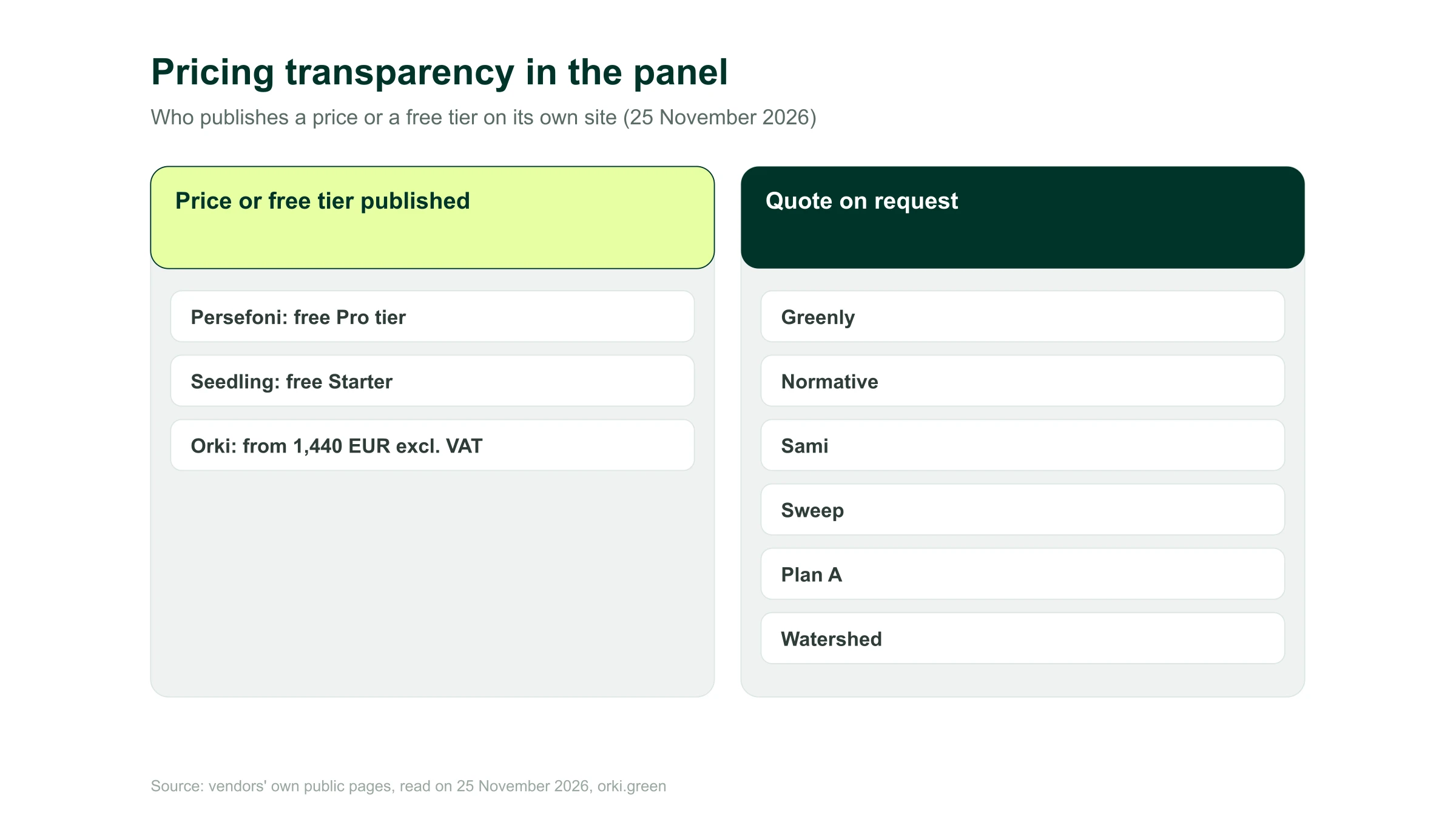 Pricing transparency in the panel: three vendors publish a price or a free tier, six quote on request (25 November 2026).
Five questions to ask in a demo
- Which emission factor databases are included, and can every factor be traced? Auditors will ask where each figure comes from.
- How is scope 3 supplier data collected? Ask to see the supplier portal or questionnaire, and how primary data replaces spend-based estimates.
- Which export matches my framework? Ask for the ESRS E1 tables, the SECR disclosure, the BEGES format or the CDP response, as relevant.
- What happens when my base year changes? Acquisitions and methodology updates require recalculations that must be documented.
- Who supports us, and how much of it is included? Named advisor, consultants, partners or a ticketing system make a large difference in the first year.
Points to remember
- Choose by deliverable, not by ranking. The right platform depends on the report you must produce and the framework behind it.
- Product LCA divides the market. Only some platforms document EN 15804+A2 EPDs alongside a corporate footprint.
- Greenly and Normative are merging. The two companies announced it in September 2026.
- Free tiers exist. Persefoni and Seedling offer free entry tiers; Orki publishes entry prices for carbon.
- Expert support is part of the product. Compare what is included as carefully as the features.
Sources
- GHG Protocol, Corporate Accounting and Reporting Standard, https://ghgprotocol.org/corporate-standard, consulted on 25 November 2026
- Greenly, Pricing, https://greenly.earth/en-us/info/pricing, consulted on 25 November 2026 (archive: https://web.archive.org/web/20261125092917/https://greenly.earth/en-us/info/pricing)
- Greenly, "Greenly and Normative are joining forces", https://greenly.earth/en-gb/blog/ecology-news/greenly-and-normative-join-forces, consulted on 25 November 2026
- Normative, Homepage, pricing and merger announcement, https://normative.io/ and https://normative.io/insight/normative-greenly-merger/, consulted on 25 November 2026
- Sami, Homepage and legal notice, https://www.sami.eco/ and https://www.sami.eco/mentions-legales, consulted on 25 November 2026
- Greenly, French site (Bilan Carbone and VSME product pages), https://greenly.earth/fr-fr, consulted on 25 November 2026
- Sweep, Homepage and About, https://www.sweep.net/, consulted on 25 November 2026 (archive: https://web.archive.org/web/20261125093211/https://www.sweep.net/)
- Plan A, Homepage and About, https://plana.earth/, consulted on 25 November 2026 (archive: https://web.archive.org/web/20261125093230/https://plana.earth/)
- Persefoni, Pricing, https://www.persefoni.com/pricing, consulted on 25 November 2026 (archive: https://web.archive.org/web/20261125093021/https://www.persefoni.com/pricing)
- Watershed, Homepage and About, https://watershed.com/, consulted on 25 November 2026 (archive: https://web.archive.org/web/20261125093351/https://watershed.com/)
- Seedling, Homepage and pricing, https://seedling.earth/, consulted on 25 November 2026 (archive: https://web.archive.org/web/20261125093131/https://www.seedling.earth/en-us/pricing)
- Orki, English product pages, https://orki.green/en/carbon-accounting-software and https://orki.green/en/lca-software, consulted on 25 November 2026
- Orki, Pricing (French), https://orki.green/tarifs, consulted on 25 November 2026