

 Carbon accounting software
 MCP: Orki in your AI assistant
 LCA software
 ESG reporting software

Since 10 November 2026, the simplified ESRS are in force, and CSRD software has to follow standards that changed in 2026.
The CSRD software market grew when the directive first set its original scope. In 2026, the rules changed twice: Omnibus I raised the thresholds, and the revised ESRS cut the number of datapoints. A tool chosen in 2024 may no longer match what a company must now report. A company that has left the scope may need a much lighter tool, or none at all.
This guide compares ten CSRD reporting platforms by use case. Every vendor profile is based only on the vendor's own public pages, read on 25 November 2026. Every regulatory statement rests on the Official Journal text or the Commission's own announcement.

In brief
- Ten platforms are compared: Workiva, Sweep, Position Green, Coolset, Greenly, Normative, Sami, Tennaxia, Toovalu and Orki.
- Best by use case: Workiva for large groups that report sustainability on the same platform as financial reporting; Sweep or Position Green for multi-framework enterprise programmes; Coolset for mid-market companies that also face EU supply-chain rules; Greenly for a benchmark-led double materiality and an SME track; Sami, Tennaxia or Toovalu for companies that want consultants alongside the tool; Orki for CSRD plus carbon accounting and product EPDs on one platform.
- None of the ten showed a CSRD price on its own site on 25 November 2026.
- Editorial disclosure: this article is published by Orki, which is one of the platforms compared. Shortlist at least three vendors and request a demo from each.
What changed for CSRD in 2026
Three legal texts now shape what a CSRD tool must handle.
Omnibus I narrowed the scope. Directive (EU) 2026/470 of 24 February 2026 entered into force on 18 March 2026. A company now reports only if it exceeds both a net turnover of 450 million euros and an average of 1,000 employees. Listed SMEs are removed from the regime. Companies of the first wave stay in the CSRD for financial years 2024 to 2026 only. From 2027, only those above the new thresholds remain, and Member States may exempt the others already for 2025 and 2026. Member States must transpose these changes by 19 March 2027.
The ESRS were simplified. Delegated Regulation (EU) 2026/1563 entered into force on 10 November 2026 and applies to financial years from 1 January 2027. For financial year 2026, companies may choose the old ESRS, the new ESRS, or the old ESRS with listed reliefs. The Commission states that the revised standards cut mandatory datapoints by over 60% and total datapoints by over 70%.
Smaller suppliers are protected by a value chain cap. Companies in the value chain with up to 1,000 employees may decline requests that go beyond the voluntary standard, Delegated Regulation (EU) 2026/1560. That standard is based on the VSME Recommendation (EU) 2025/1710. Contract clauses asking for more are not binding. The cap applies from financial year 2027.
Two practical consequences follow. First, ask every vendor how and when its datapoint library moves to the revised ESRS. Second, if your company is now out of scope but receives questionnaires from customers, a VSME module may be all you need.
How we compared the platforms
Only what is written on each vendor's own site was recorded. When a feature does not appear on the pages we read, the table says "not stated", which does not mean the feature is missing: ask the vendor.
The 10 platforms at a glance
Every platform in the panel states a materiality assessment module or service, a data collection workflow, and some form of audit trail or audit-ready reporting. The differences lie in the depth of each function, the frameworks covered on the same data, and the support model.
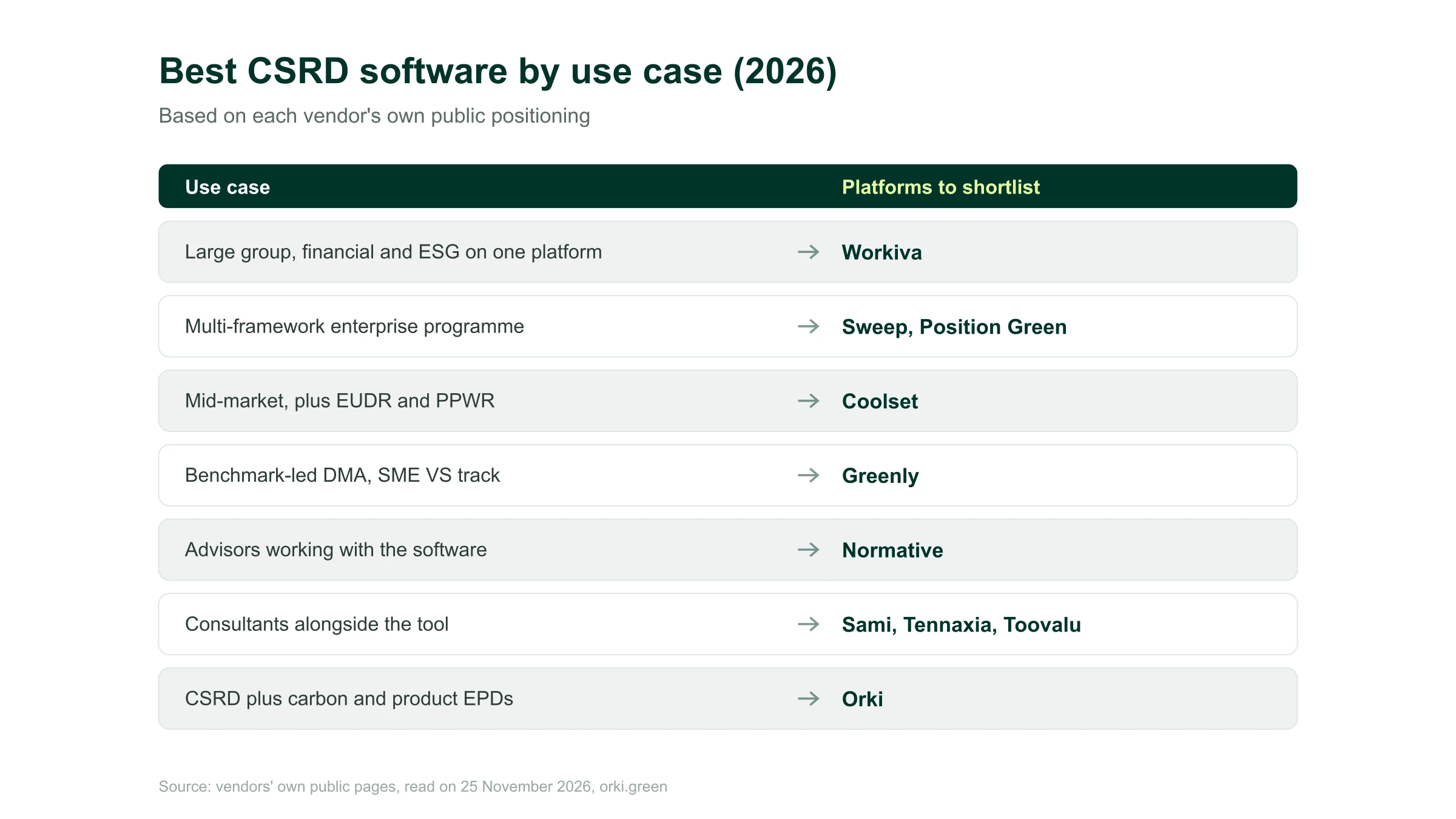 Use cases are based on each vendor's own public positioning, read on 25 November 2026.
Best CSRD software by use case
For large groups reporting sustainability with financial filings: Workiva
Workiva, founded as WebFilings in 2008, puts sustainability reporting on the same platform as financial reporting, SOX, audit and risk. Its CSRD page states an integrated double materiality assessment with IROs linked to the final disclosures, and an ESRS gap analysis. It also lists over 60 connectors with ERP, HR, EHS and carbon systems, and an "Audit and assurance hub" with audit trails. Its CSRD page is explicit on digital tagging: "XBRL tagging for ESRS, Article 8, ESEF and local taxonomies". Other frameworks named include TCFD and ISSB, CDP and GRI, and Workiva Carbon covers scopes 1, 2 and 3 under the GHG Protocol. Workiva states it was named a Leader in the Verdantix 2025 Green Quadrant for ESG and Sustainability Reporting Software. Its customer figures, 6,800+ customers and 85% of the Fortune 1000, point to large groups. Workiva states that all its offerings include unlimited users.
For multi-framework enterprise programmes: Sweep and Position Green
Sweep, based in Paris and London, describes a step-by-step CSRD workflow. It starts with a double materiality assessment by sector, then surveys and file imports with a validation workflow. Internal controls track all changes with comments and supporting documents, and indicators are tagged "for machine-readable format suited for the ESAP platform". It lists CSRD/ESRS, CDP, GRI, ISSB, EU Taxonomy and SBTi-aligned target setting on one platform, and offers a free CSRD Materiality Builder. Sweep cites Leader positions in the IDC MarketScape 2026 and the Verdantix 2026 Green Quadrant, both for carbon management. It has tracks for enterprise, midmarket and financial institutions.
Position Green, founded in 2015 and headquartered in Sweden with offices across Northern Europe, addresses large European companies with complex structures. It states that it covers "both the standard and Revised ESRS", which is useful in the 2026 transition year. It offers ready-made ESRS templates and a double materiality module on impact and financial axes. That module keeps an audit trail of who contributed or approved each step. It also offers a dedicated VSME product, with an upgrade path from basic to comprehensive VS and data reuse for ESRS, GRI and ISSB. Other modules cover EU Taxonomy assessments and GRI and ISSB mapping, with ERP integrations for SAP S/4HANA, Oracle NetSuite and Microsoft Dynamics 365. Its advisory practice states more than 100 in-house advisors. A badge on its site shows it in the Verdantix Green Quadrant 2025 for ESG and Sustainability Reporting Software. Its site states that Norvestor has been its majority investor since 2022.
For mid-market companies that also face EU supply-chain rules: Coolset
Coolset, an Amsterdam company, titles its page "CSRD software for mid-market enterprises". Its CSRD module includes a 4-week accelerator programme, a double materiality assessment, ESRS topic disclosures, guided templates and audit-ready reports. It states an audit trail and "preparation for seamless XBRL integration". Separate modules cover VSME, EU Taxonomy, EcoVadis and GHG scopes 1 to 3, and supply-chain modules cover EUDR, PPWR and EUTR. Coolset states that onboarding and support are included at no additional cost and that it offers access to vetted auditors for limited assurance. It also offers an MCP connection for AI tools. Each module is quoted on request.
For a benchmark-led double materiality and an SME track: Greenly
Greenly, a French company, publishes a detailed CSRD feature list. Its double materiality is built "on a 400-IRO sector benchmark", and an ESRS gap analysis shows which disclosures lack data, owners or evidence. Each datapoint has Owner, Validator, Contributor and Auditor roles, with every entry and edit logged. The auditor gets read-only access to the trail behind each reported figure, and the statement exports "in XHTML with XBRL tagging". The same data is reused for EcoVadis, IFRS S2, CDP and California SB 253. For SMEs, Greenly offers a "VS" product with a one-click report. Greenly states that its CSRD experts support customers at each step. Its CSRD price depends mainly on the number of entities and on full CSRD versus VS, and is quoted on request.
For advisors working alongside the software: Normative
Normative, based in Stockholm, states in-platform coverage across ESRS 2, E, S and G, with centralised collection and guided approval workflows. It also states a built-in audit trail and pre-disclosure support to evaluate auditability before the report is final. It names a team of 20 GHG Protocol-certified Climate Strategy Advisors and an in-house CSRD specialist. CSRD sits in the reporting suite of all packages. VSME appears as an advisory service. In September 2026, Greenly and Normative announced that they are merging, according to both companies' press releases. Greenly states that no changes are planned to existing contracts or pricing as a direct result of the merger.
For French companies that want experts alongside the tool: Sami, Tennaxia and Toovalu
Sami chains its ESG Hub modules from an initial diagnosis and maturity assessment to double materiality, gap analysis, data collection and the report. Its double materiality module proposes IROs with AI, scores them on the EFRAG grid and allows unlimited stakeholder questionnaires; each datapoint has a contributor and a verifier. For VSME, its consultants configure the datapoints in the software and run co-construction workshops. Sami Pro also lets consultants use the platform for their own clients. Sami states that reports and data export in the regulatory format, and its report module exports as PDF or XML.
Tennaxia, founded in 2001 and headquartered in Changé, near Laval, presents itself as an EHS, ESG and carbon software suite backed by consultants. Its CSRD gap analysis works at datapoint level, with all Disclosure Requirements pre-filled and, for each datapoint, its materiality, expected data availability and supporting documents. It also offers a double materiality module and multi-framework reporting including VSME. It states more than 90 in-house ESG, carbon and EHS experts, and more than 1,000 clients including over half of the CAC 40. It also states SOC 2 Type 2 and ISO 27001. Its timeline states that Marlin Equity Partners invested in 2023 and that it acquired the carbon SaaS Traace in 2024.
Toovalu, based in Nantes and part of the Lefebvre group since 2024, covers the 12 ESRS standards and links material IROs to ESRS topics. For each datapoint it keeps the source, owner, calculation method and evidence, gives auditors a dedicated access, and states that it generates CSRD-compliant XBRL reports. It has a dedicated VS (ex-VSME) page, Bilan Carbone software listed by the Association pour la transition Bas Carbone, and relies on the Lefebvre group's legal experts for regulatory watch. Support comes from its own experts or more than 60 partner consulting firms. Its site is in French.
For CSRD plus carbon accounting and product EPDs: Orki
Orki is a French publisher headquartered in Paris that combines a SaaS platform with senior consultants. Its ESG module manages CSRD, VSME and EcoVadis indicators on one platform, with the ESRS framework built in and "continuously updated". It includes a built-in double materiality (IRO analysis and matrix) and API and SFTP connectors for HR, accounting and purchasing data. It also offers an evidence library, a native audit trail, and an export of ESRS tables "in the official format". Orki's scope goes beyond CSRD. The same platform covers carbon accounting under the GHG Protocol, ISO 14064 and Bilan Carbone. It also covers product LCA and EPDs under ISO 14040/44 and EN 15804+A2, including French FDES and PEP ecopassport declarations. Greenly, Sami, Toovalu and Normative also name product footprint or LCA offers on their sites. A manufacturer can therefore reuse its carbon inventory for ESRS E1 and produce the product declarations its customers ask for. Orki also offers an MCP connector so that Claude, ChatGPT, Le Chat or Copilot can read Orki data. It states that support is included in the licence, with an average response time under 40 minutes.
Limits to weigh: ESG offers are priced on request, and only the carbon tiers have public prices, on Orki's French pricing page. XBRL export is not documented on Orki's English pages as of 25 November 2026, and no analyst ranking is cited on its site. It suits SMEs and mid-caps more than multinational groups that need financial and sustainability filings on one platform.
Which features matter after the Omnibus
The 2026 changes shift the weight of some selection criteria.
- Revised ESRS readiness. The new datapoint set is mandatory from financial year 2027. Ask whether the vendor's library already maps the revised ESRS, and whether it can produce a 2026 report under the old ESRS with reliefs. Position Green states coverage of both versions.
- Double materiality that you can defend. Look for IRO scoring on a documented grid, stakeholder input and a trail of who decided what. Several vendors describe this in detail, including Greenly, Sami, Position Green and Toovalu.
- Evidence per datapoint. Assurance remains limited assurance, and the Commission must adopt limited assurance standards by 1 July 2027. An auditor will still ask for the source of each figure. Auditor access, as stated by Greenly and Toovalu, saves file exchanges.
- VSME and the value chain cap. From financial year 2027, a supplier with up to 1,000 employees can decline requests beyond the voluntary standard. A VSME module lets you answer customers in a standard format.
- Data reuse across frameworks. Climate data feeds ESRS E1, CDP, EcoVadis and customer questionnaires. Check that the tool reuses one dataset rather than asking you to collect twice.
- Digital export. XBRL is useful to prepare; the amended Accounting Directive requires mark-up only once tagging rules are adopted in Delegated Regulation (EU) 2019/815. Compare the exact wording each vendor uses.
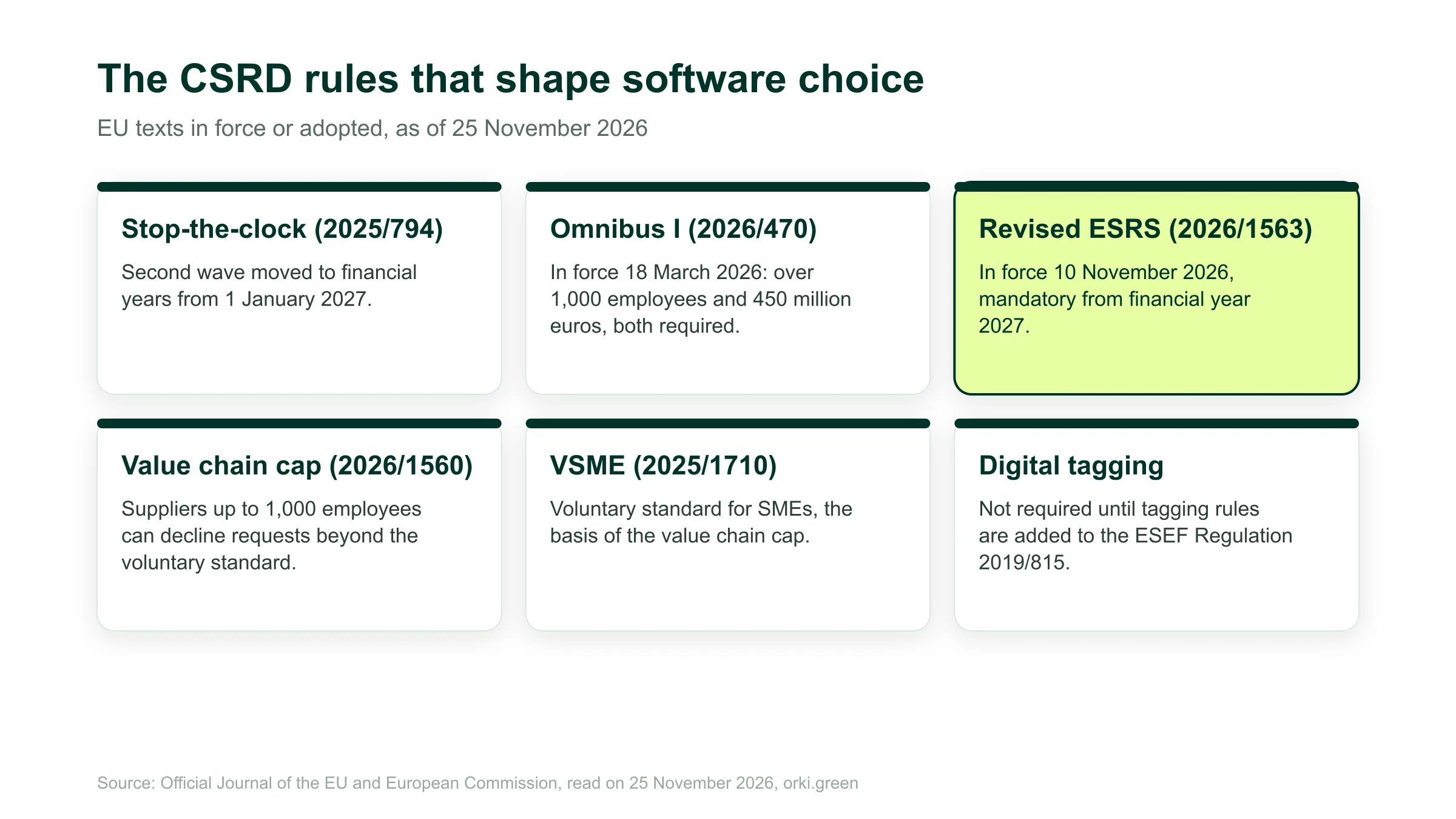 Sources: Official Journal of the European Union and European Commission, read on 25 November 2026.
What CSRD software costs
As of 25 November 2026, none of the ten shows a price for its CSRD module on its own site. Every CSRD offer in this panel is quoted on request. A few vendors do publish the main cost drivers or what is included:
- Greenly says its price depends mainly on the number of entities to consolidate and on full CSRD versus VS.
- Workiva states that all its offerings include unlimited seats or users.
- Coolset states that onboarding and support are included at no additional cost.
- Normative includes CSRD in the reporting suite of all its packages.
- Orki publishes carbon accounting prices on its French pricing page, from 1,440 euros excluding VAT for the entry tier for small service companies. Its ESG offers are on request, with unlimited users and no commitment.
Six questions to ask in a demo
- How will the datapoint library move to the revised ESRS, and can we report 2026 under the old ESRS with reliefs?
- Show the double materiality: how are IROs proposed, scored and documented, and who validated each decision?
- For one published figure, show the source, the calculation, the owner, the validator and the evidence.
- What exactly does your digital export produce today, and what will change when the ESEF tagging rules are adopted?
- Can we answer VSME requests and EcoVadis or CDP questionnaires from the same data?
- What is included in the price: users, entities, connectors, experts, and support response times?
Related comparisons. See also our guides to carbon accounting software by use case and Greenly alternatives.
Points to remember
- The simplified ESRS have been in force since 10 November 2026. They are mandatory from financial year 2027, so check every vendor's transition plan.
- From financial year 2027, scope is 1,000 employees and 450 million euros, both required. Many companies have left the scope and may need a VSME module rather than a full CSRD tool.
- XBRL tagging of the sustainability statement is not required until ESEF rules are adopted. Compare the exact export wording, but do not choose on this alone.
- None of the ten showed a CSRD price on its site on 25 November 2026. Ask for quotes on the same scope.
- The right tool depends on your profile. Workiva fits large groups reporting sustainability with financial filings, and Sweep and Position Green fit multi-framework enterprise programmes. Coolset fits the mid-market, and Greenly offers a benchmark-led DMA. Sami, Tennaxia and Toovalu combine the tool with consultants, and Orki combines CSRD with carbon and product EPDs.
Sources
- European Union, Directive (EU) 2026/470 of 24 February 2026 (Omnibus I), https://eur-lex.europa.eu/eli/dir/2026/470/oj, consulted on 25 November 2026 (archive: https://web.archive.org/web/20261125130236/https://eur-lex.europa.eu/eli/dir/2026/470/oj)
- European Union, Directive (EU) 2025/794 of 14 April 2025 (stop-the-clock), https://eur-lex.europa.eu/eli/dir/2025/794/oj, consulted on 25 November 2026 (archive: https://web.archive.org/web/20261125130414/https://eur-lex.europa.eu/eli/dir/2025/794/oj)
- European Union, Directive (EU) 2022/2464 (CSRD), https://eur-lex.europa.eu/eli/dir/2022/2464/oj, consulted on 25 November 2026 (archive: https://web.archive.org/web/20261125130545/https://eur-lex.europa.eu/eli/dir/2022/2464/oj)
- European Commission, Recommendation (EU) 2025/1710 of 30 July 2025 on a voluntary sustainability reporting standard for SMEs, https://eur-lex.europa.eu/eli/reco/2025/1710/oj, consulted on 25 November 2026 (archive: https://web.archive.org/web/20261125130722/https://eur-lex.europa.eu/eli/reco/2025/1710/oj)
- European Commission, Delegated Regulation (EU) 2026/1560 of 3 July 2026 (voluntary standards and value chain cap), https://eur-lex.europa.eu/eli/reg_del/2026/1560/oj, consulted on 25 November 2026
- European Commission, Delegated Regulation (EU) 2026/1563 of 3 July 2026 (revised ESRS), https://eur-lex.europa.eu/eli/reg_del/2026/1563/oj, consulted on 25 November 2026 (archive: https://web.archive.org/web/20261125130806/https://eur-lex.europa.eu/eli/reg_del/2026/1563/oj)
- European Commission, "Commission adopts revised sustainability reporting standards", 3 July 2026, https://finance.ec.europa.eu/news/commission-adopts-revised-sustainability-reporting-standards-reduce-administrative-burdens-eu-2026-07-03_en, consulted on 25 November 2026 (archive: https://web.archive.org/web/20261125131040/https://finance.ec.europa.eu/news/commission-adopts-revised-sustainability-reporting-standards-reduce-administrative-burdens-eu-2026-07-03_en)
- Workiva, Home, CSRD reporting, About, Pricing and Verdantix 2025 announcement, https://www.workiva.com/, https://www.workiva.com/solutions/csrd-reporting, https://www.workiva.com/about, https://www.workiva.com/pricing and https://www.workiva.com/blog/workiva-named-leader-verdantix-green-quadrant-esg-sustainability-reporting-software-2025, consulted on 25 November 2026
- Sweep, Home, About and CSRD, https://www.sweep.net/, https://www.sweep.net/about and https://www.sweep.net/csrd, consulted on 25 November 2026 (archive: https://web.archive.org/web/20261125130214/https://www.sweep.net/csrd)
- Position Green, Home, About, advisory, ESRS reporting, materiality assessment and VSME reporting, https://www.positiongreen.com/, https://www.positiongreen.com/about/, https://www.positiongreen.com/advisory/, https://www.positiongreen.com/esg-solutions/esrs-reporting/, https://www.positiongreen.com/materiality-assessment/ and https://www.positiongreen.com/esg-solutions/vsme-reporting/, consulted on 25 November 2026 (archives: https://web.archive.org/web/20261125130915/https://www.positiongreen.com/esg-solutions/esrs-reporting/, https://web.archive.org/web/20261125130843/https://www.positiongreen.com/about/ and https://web.archive.org/web/20261125130948/https://www.positiongreen.com/materiality-assessment/)
- Coolset, Home, CSRD, plans and company, https://www.coolset.com/, https://www.coolset.com/csrd, https://www.coolset.com/pricing and https://www.coolset.com/company, consulted on 25 November 2026 (archives: https://web.archive.org/web/20261125131020/https://www.coolset.com/csrd and https://web.archive.org/web/20261125131045/https://www.coolset.com/plans)
- Greenly, CSRD reporting (EN and FR), VS and French site, https://greenly.earth/en-us/products/csrd-reporting, https://greenly.earth/fr-fr/csrd-reporting, https://greenly.earth/fr-fr/vsme and https://greenly.earth/fr-fr, consulted on 25 November 2026 (archives: https://web.archive.org/web/20261125131206/https://greenly.earth/en-us/products/csrd-reporting, https://web.archive.org/web/20261125130412/https://greenly.earth/produits/csrd-reporting and https://web.archive.org/web/20261125130444/https://greenly.earth/produits/vsme)
- Greenly, "Greenly and Normative are joining forces", https://greenly.earth/en-gb/blog/ecology-news/greenly-and-normative-join-forces, consulted on 25 November 2026
- Normative, About, CSRD solution, pricing and merger announcement, https://normative.io/about/, https://normative.io/platform/csrd-solution/, https://normative.io/pricing/ and https://normative.io/insight/normative-greenly-merger/, consulted on 25 November 2026
- Sami, Home, CSRD support, VSME, double materiality, data collection and sustainability report, https://www.sami.eco/en, https://www.sami.eco/en/services/csrd-support, https://www.sami.eco/en/services/vsme, https://www.sami.eco/en/software/esg/double-materiality-analysis, https://www.sami.eco/en/software/esg/data-collection and https://www.sami.eco/en/software/esg/sustainability-report, consulted on 25 November 2026 (archives: https://web.archive.org/web/20261125130801/https://www.sami.eco/en/software/esg/double-materiality-analysis, https://web.archive.org/web/20261125130625/https://www.sami.eco/en/services/csrd-support and https://web.archive.org/web/20261125130655/https://www.sami.eco/en/services/vsme)
- Tennaxia, Home, Why Tennaxia, CSRD gap analysis, double materiality, ESG reporting and legal notice, https://www.tennaxia.com/en, https://www.tennaxia.com/en/why-tennaxia, https://www.tennaxia.com/en/plateforme/anticipations-risques/csrd-gap-analysis, https://www.tennaxia.com/en/plateforme/mesure-impact/analyse-double-materialite, https://www.tennaxia.com/en/plateforme/reporting-progres/reporting-esg-carbone and https://www.tennaxia.com/en/mentions-legales, consulted on 25 November 2026 (archives: https://web.archive.org/web/20261125131220/https://www.tennaxia.com/en/plateforme/anticipations-risques/csrd-gap-analysis, https://web.archive.org/web/20261125131105/https://www.tennaxia.com/en and https://web.archive.org/web/20261125131239/https://www.tennaxia.com/en/why-tennaxia)
- Toovalu, Home, CSRD software, VS (ex-VSME) and About, https://www.toovalu.com/, https://www.toovalu.com/logiciel-rse/csrd, https://www.toovalu.com/logiciel-rse/vs-ex-vsme and https://www.toovalu.com/a-propos, consulted on 25 November 2026 (archives: https://web.archive.org/web/20261125131422/https://www.toovalu.com/logiciel-rse/csrd, https://web.archive.org/web/20261125131259/https://www.toovalu.com/ and https://web.archive.org/web/20261125131445/https://www.toovalu.com/a-propos)
- Orki, Home, ESG reporting software, carbon accounting software and llms.txt, https://orki.green/en, https://orki.green/en/esg-reporting-software, https://orki.green/en/carbon-accounting-software and https://orki.green/llms.txt, consulted on 25 November 2026
- Orki, Tarifs (French pricing page), https://orki.green/tarifs, consulted on 25 November 2026
- Orki, MCP connector, https://orki.green/en/mcp, consulted on 25 November 2026